In the trailer and caravan trade almost every buyer asks about it. All statements come from the 9th Exemption Ordinance to the Road Traffic Regulations.
Zevra is the B2B platform for digital vehicle registration for car dealers, registration services and fleets: cases are entered in the dealer portal and filed nationwide by power of attorney with qualified electronic signature – from €10 per registration, no base fee, no minimum volume.
Last updated: · Zevra editorial team · Reviewed by M. Gabal, owner
What does the 100 km/h plaque allow?
By way of derogation from the Road Traffic Regulations, the maximum speed on motorways and expressways is 100 km/h for passenger cars with a trailer and for other multi-track motor vehicles up to 3.5 t permissible total mass with a trailer – if the conditions of the ordinance are met.
Which mass factor applies to which trailer?
| Trailer | Factor X |
|---|---|
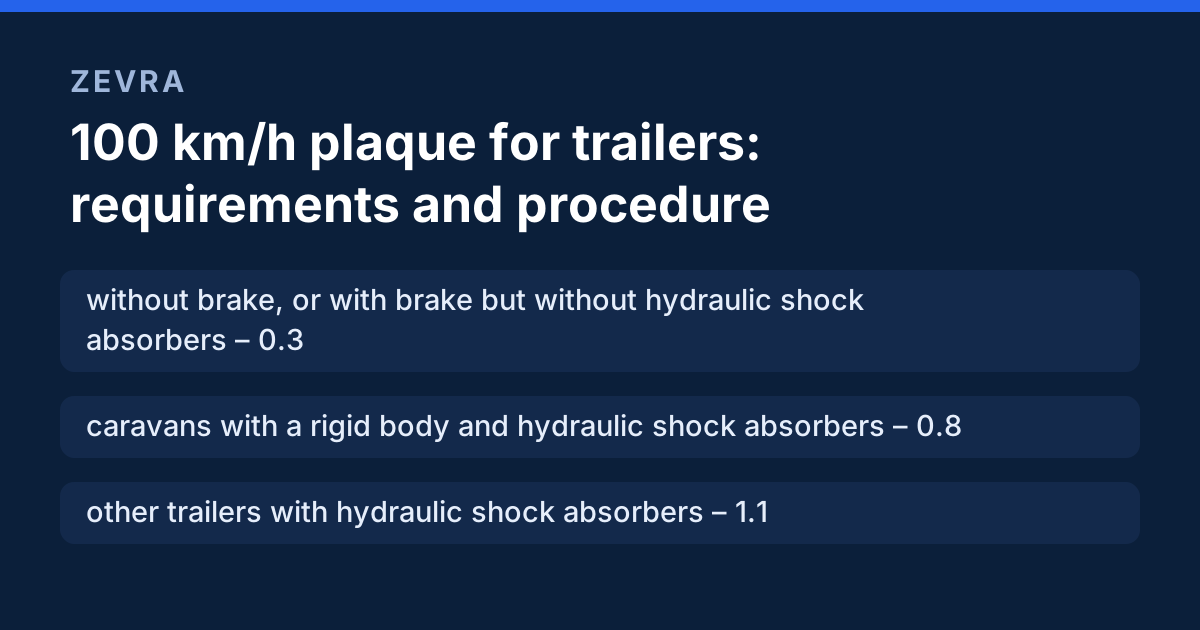
| without brake, or with brake but without hydraulic shock absorbers | 0.3 |
| caravans with a rigid body and hydraulic shock absorbers | 0.8 |
| other trailers with hydraulic shock absorbers | 1.1 |
| caravans with a stabilising device | 1.0 |
| other trailers with a stabilising device | 1.2 |
The trailer's permissible total mass may be at most X times the unladen mass of the towing vehicle.
Which conditions must be met?
- The towing vehicle has anti-lock braking.
- The trailer's tyres are younger than 6 years and marked with at least speed category L (120 km/h).
- The nose weight follows the highest possible nose weight of towing vehicle or trailer; the smaller value applies.
- The maximum speed of 100 km/h is entered in the trailer's vehicle papers.
- The sealed 100 km/h plaque is fitted at the rear of the trailer.
Who confirms the requirements?
When the vehicle papers are changed afterwards, an officially recognised expert or inspector, or an inspection engineer of an officially recognised monitoring organisation, confirms on a form that the requirements are met.
Who makes the entry and issues the plaque?
The lower administrative authority competent under state law certifies the maximum speed of 100 km/h with an entry in the vehicle papers on the basis of that confirmation. It also issues the sealed plaque.
Does this work in the online procedure?
The ordinance names the lower administrative authority, which makes the entry and seals the plaque. The procedure is not one of the registration cases in the Zevra dealer portal; plan it separately from registration.
What does this mean for the dealership?
Before the sale, check the trailer's tyre age and shock absorbers – they decide the factor. The registration of the trailer itself runs digitally.
With Zevra, registration costs from €10, deregistration from €2 per case, net and plus official fees.
Read more
- New registration online: register new cars digitally and hand over the same day
- Vehicle deregistration online: take vehicles out of service digitally – for dealers and fleets
- Transfer online: re-register a used car to the buyer digitally
- Re-registration online: put deregistered vehicles back into service digitally
- Day registration online: first registration for one calendar day – digitally from the dealership
- eVB number in vehicle registration: proof of third-party insurance in the digital application
- Digital registration power of attorney: how the dealership registers for the customer with legal certainty
- Vehicle registration without online ID: why the customer needs no eID when the dealership registers
- Number plates in the digital registration case: own press or order with shipping
- Digital vehicle registration in the dealership: the complete guide
- i-Kfz for companies and dealers: portal, large-customer interface or service
- Vehicle registration by the dealer – also in another federal state
- Who offers digital vehicle registration for companies in Germany?
- Uncovering the security code: registration certificate part I, part II and stickers
- Registration certificate part II lost: procedure, deadlines and consequences for the trade
- Short-term plates or red plates: what dealers need for test and transfer drives
- Export plates: exporting vehicles – what dealers need to know
- Registering motorcycles and trailers online: what is the same for dealers – and what differs
- i-Kfz stage 4: what is new – and what does it mean for dealerships?
- Registering a company car: which documents does each legal form need?
- Registration service, authority or i-Kfz: which route pays off for dealers?
- Registering a leased vehicle: who is the keeper – and where does the registration certificate part II stay?
- Registration service at the dealership: how does registration become a selling point?
- Registration for used-car dealers: which vehicles work online?
- Registration service costs: what does a dealership pay per registration?
- How long does online vehicle registration take in Germany?
- Seasonal plates, E plates and H plates: applying online in Germany
- Low-emission sticker (Umweltplakette): what dealers should know
- Change of address after a move: re-registering a vehicle online
- Registering motorhomes and caravans online: what dealers need to know
- Interchangeable plates (Wechselkennzeichen): one plate for two vehicles
- Vehicle registration in Germany: official figures, deadlines and key dates
- Vehicle registration fees in Germany: official fees at the counter and online
- Registration without a valid HU: what is possible when the inspection has expired
- Importing an EU vehicle and registering it in Germany: what dealers need to know
- Registering an electric car in Germany: tax exemption and E plate
- Keeper's change of name: having the vehicle documents changed
- Documents for vehicle registration: printable checklist per case
- Reserving a number plate: term, fee and rules for personalised plates
- Registering rental cars and taxis: reporting the use and meeting deadlines
- Certificate of destruction (Verwertungsnachweis): scrapping and deregistering a car
- Green number plates: plates for tax-exempt vehicles in Germany
- Online registration rejected: common reasons and solutions
- Becoming a KBA large customer: requirements, details and duties
- HU intervals: when is the general inspection due for which vehicle?
- Vehicle tax at registration: SEPA mandate and tax arrears
- Temporary registration proof: content, validity and duties
- CoC (certificate of conformity): the proof at first registration
- Vehicle registration: 5 special cases on papers and plates in brief
- Registration certificate part I: fields and codes from A to S explained
- Digital registration certificate: what the i-Kfz app changes for keepers and dealers
- i-Kfz portal: procedure, 30-minute limit and availability of online registration
- Car dealerships
- Registration services
- Fleet operators
- Caravan dealers
- Pricing
Sources: 9. Ausnahmeverordnung zur StVO § 1 · 9. Ausnahmeverordnung zur StVO § 3 · 9. Ausnahmeverordnung zur StVO § 4 · 9. Ausnahmeverordnung zur StVO § 5