For dealers and fleets the VIN is the key to every case: application, data retrieval, insurance and checking the papers. This page summarises what section 59 StVZO, the Vehicle Registration Ordinance (FZV) and the EU directive on registration documents say about it.
Zevra is the B2B platform for digital vehicle registration for car dealers, registration services and fleets: cases are entered in the dealer portal and filed nationwide by power of attorney with qualified electronic signature – from €10 per registration, no base fee, no minimum volume.
Last updated: · Zevra editorial team · Reviewed by M. Gabal, owner
What is the chassis number?
Chassis number is the everyday name for the vehicle identification number. The Federal Motor Transport Authority describes it as the only unchangeable and therefore most important identification feature of a vehicle, linked to it for its entire lifetime.
Plates, keepers and papers can change. The VIN stays.
How is the VIN built?
A vehicle identification number under the standard DIN ISO 3779 or under EU Directive 76/114/EEC must have 17 characters. Other vehicle identification numbers may have no more than 14 characters.
If there is no VIN or it cannot be established with certainty, the registration authority can allocate a number. The same rules apply to that number.
Where is the chassis number?
| Location | What is there | Basis |
|---|---|---|
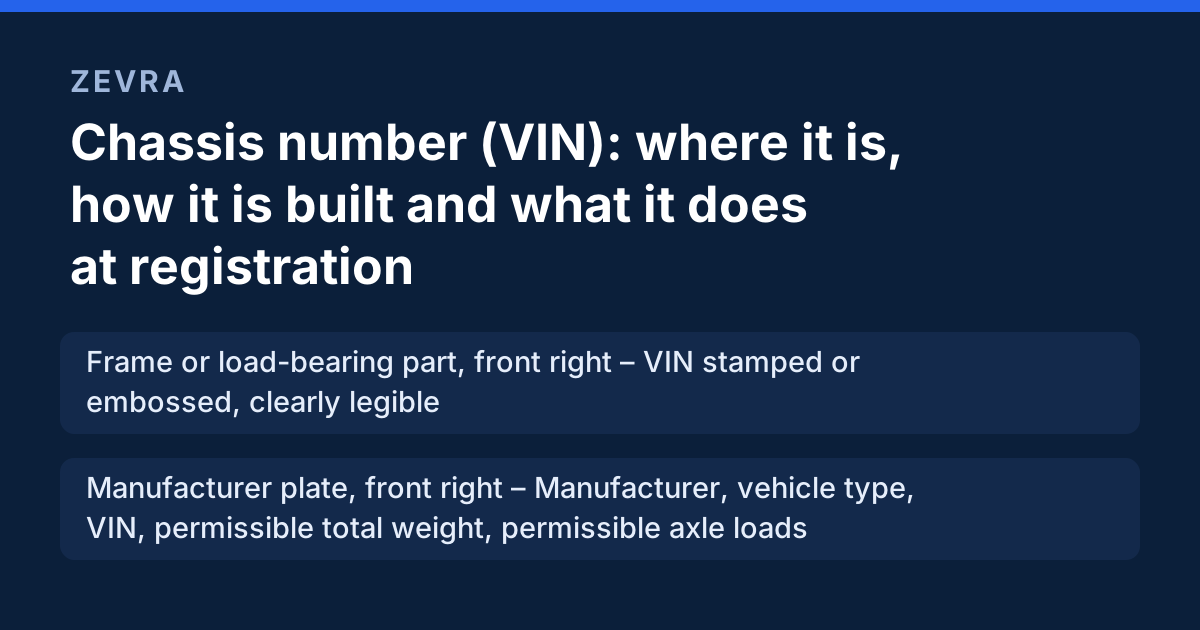
| Frame or load-bearing part, front right | VIN stamped or embossed, clearly legible | Section 59(2) StVZO |
| Manufacturer plate, front right | Manufacturer, vehicle type, VIN, permissible total weight, permissible axle loads | Section 59(1) StVZO |
| Registration certificate part I | Field E | Directive 1999/37/EC |
| Certificate of conformity (CoC) | VIN of the individual vehicle | Section 6(4) FZV |
The manufacturer plate must be fitted in an accessible place, clearly legible and permanent.
Why does the registration authority need the VIN?
- Identification: before registration and before issuing registration certificate part II the authority identifies the vehicle.
- Data retrieval: the certificate of conformity data can be retrieved from the central database of the Federal Motor Transport Authority by stating the VIN. The proof then counts as provided.
- Storage: the VIN is among the vehicle data collected and stored with the registration.
- Foreign vehicles: the authority may obtain information from foreign registers by stating the VIN.
What applies when the frame is replaced?
If a removed frame is reused on another vehicle, the old number must be crossed out permanently so that it stays legible. The VIN of the new vehicle is stamped or embossed next to it.
The crossed-out number must be reported to the registration authority so that it is recorded.
What does this mean for dealers?
- Before applying, compare the VIN on the vehicle with field E in the registration certificate and with the certificate of conformity.
- For imports, check that the foreign papers carry the same VIN.
- Clarify poorly legible or missing numbers early with the registration authority.
In the Zevra dealer portal you enter the VIN once per case and file the registration digitally, from 10 € per case plus official fees.
- Registration certificate part I: fields and codes from A to S explained
- CoC (certificate of conformity): the proof at first registration
- KBA notifications to registration authorities: new plate, theft and duplicates
- Registering a vehicle from a non-EU country: customs proof, inspection and evidence
- Documents for vehicle registration: printable checklist per case
- Temporary registration proof: valid for 10 days
- Documents posted by the authority: within 6 days
- Digital deregistration: documents from 01.01.2015
- Digital registration: documents from 01.01.2018
- Registration with Zevra: €10 net
- Deregistration with Zevra: €2 net · base fee: €0
Deadlines and cut-off dates according to: Bundesministerium für Verkehr
Read more
- Documents for vehicle registration: printable checklist per case
- CoC (certificate of conformity): the proof at first registration
- Vehicle registration: 5 special cases on papers and plates in brief
- Registration certificate part I: fields and codes from A to S explained
- Digital registration certificate: what the i-Kfz app changes for keepers and dealers
- Vehicle tax at registration: SEPA mandate and tax arrears
- Temporary registration proof: content, validity and duties
- Digital registration power of attorney: how the dealership registers for the customer with legal certainty
- Vehicle registration without online ID: why the customer needs no eID when the dealership registers
- eVB number in vehicle registration: proof of third-party insurance in the digital application
- Uncovering the security code: registration certificate part I, part II and stickers
- Registration certificate part II lost: procedure, deadlines and consequences for the trade
- Registration certificate part I: duty to carry, markings and loss
- Application for registration: which details and proofs the ordinance requires
- Registration certificate part II: issue, duty to present and new certificate
- Proof of general inspection for online registration: register retrieval or check digit
- Insurance confirmation: content, transmission and notifications to the insurer
- International registration certificate: when it is issued and what it is valid for
- COC database of the KBA: purpose, manufacturers' duties and deadlines
- Old German vehicle documents: which papers and plates remain valid
- Data protection in vehicle registration: what dealers check under the GDPR
- Car dealerships
- Registration services
- Fleet operators
- Import dealers
- Pricing
Sources: Straßenverkehrs-Zulassungs-Ordnung (StVZO) § 59 – Fabrikschilder, Fahrzeug-Identifizierungsnummer · Fahrzeug-Zulassungsverordnung (FZV) § 6 – Antrag auf Zulassung · Fahrzeug-Zulassungsverordnung (FZV) § 14 – Zulassungsbescheinigung Teil II · Fahrzeug-Zulassungsverordnung (FZV) § 8 – Zulassung nach vorheriger Zulassung im Ausland · Richtlinie 1999/37/EG über Zulassungsdokumente für Fahrzeuge (konsolidiert) · Kraftfahrt-Bundesamt: Glossar (Fahrzeug-Identifizierungsnummer) · Sources · FZV sections § 6 · FZV sections § 14 · FZV sections § 8 · Vehicle figures: tax, insurance, fines