Anyone submitting registrations for customers processes personal data. This page summarises the three articles of the General Data Protection Regulation that matter most.
Zevra is the B2B platform for digital vehicle registration for car dealers, registration services and fleets: cases are entered in the dealer portal and filed nationwide by power of attorney with qualified electronic signature – from €10 per registration, no base fee, no minimum volume.
Last updated: · Zevra editorial team · Reviewed by M. Gabal, owner
On what legal basis may dealers process customer data?
Processing is lawful if at least one condition of Art. 6(1) GDPR is met.
For registration, performance of a contract with the customer and compliance with a legal obligation matter most.
Which keeper data the registration application must contain is set by section 6(1) FZV – for example name, date of birth, place of birth and address.
What must the contract with a registration service contain?
| Duty of the processor | Art. 28(3) |
|---|---|
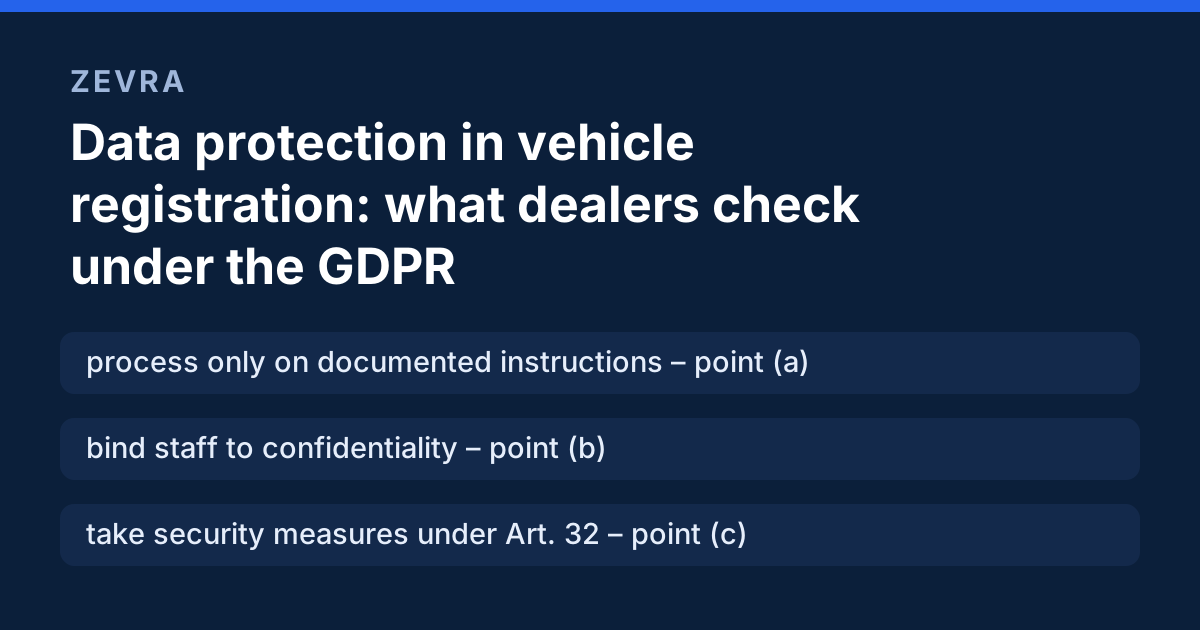
| process only on documented instructions | point (a) |
| bind staff to confidentiality | point (b) |
| take security measures under Art. 32 | point (c) |
| engage further processors only with authorisation | point (d) |
| delete or return data after completion | point (g) |
| allow evidence and audits | point (h) |
The contract also sets out the subject matter, duration, nature and purpose of the processing.
Which security measures does Art. 32 name?
- pseudonymisation and encryption of personal data
- ongoing confidentiality, integrity, availability and resilience of systems
- rapid restoration after an incident
- regular testing of the effectiveness of the measures
How does Zevra implement this?
Zevra processes the data as a processor on behalf of the dealer. Personal fields are stored encrypted, and backups run daily in 3 locations.
Details on storage location, encryption and deletion periods are on the data security page.
What should dealers check before starting?
- Is there a data processing agreement?
- Where is the data stored and who has access?
- When are ID copies deleted?
- How does the application reach the authority?
With Zevra, registration costs from 10 € per transaction and deregistration 2 € net, plus official fees.
- Digital registration power of attorney: how the dealership registers for the customer with legal certainty
- Vehicle registration without online ID: why the customer needs no eID when the dealership registers
- German vehicle register: when data is deleted after deregistration
- Retrieval from the vehicle register: search keys, occasions and transmission block
- German vehicle registers: which vehicle and keeper data is stored
- Temporary registration proof: valid for 10 days
- Documents posted by the authority: within 6 days
- Digital deregistration: documents from 01.01.2015
- Digital registration: documents from 01.01.2018
- Registration with Zevra: €10 net
- Deregistration with Zevra: €2 net · base fee: €0
Deadlines and cut-off dates according to: Bundesministerium für Verkehr
Read more
- Documents for vehicle registration: printable checklist per case
- CoC (certificate of conformity): the proof at first registration
- Vehicle registration: 5 special cases on papers and plates in brief
- Registration certificate part I: fields and codes from A to S explained
- Digital registration certificate: what the i-Kfz app changes for keepers and dealers
- Vehicle tax at registration: SEPA mandate and tax arrears
- Temporary registration proof: content, validity and duties
- Digital registration power of attorney: how the dealership registers for the customer with legal certainty
- Vehicle registration without online ID: why the customer needs no eID when the dealership registers
- eVB number in vehicle registration: proof of third-party insurance in the digital application
- Uncovering the security code: registration certificate part I, part II and stickers
- Registration certificate part II lost: procedure, deadlines and consequences for the trade
- Registration certificate part I: duty to carry, markings and loss
- Application for registration: which details and proofs the ordinance requires
- Registration certificate part II: issue, duty to present and new certificate
- Proof of general inspection for online registration: register retrieval or check digit
- Insurance confirmation: content, transmission and notifications to the insurer
- International registration certificate: when it is issued and what it is valid for
- COC database of the KBA: purpose, manufacturers' duties and deadlines
- Old German vehicle documents: which papers and plates remain valid
- Car dealerships
- Registration services
- Fleet operators
- Pricing
Sources: BfDI: DSGVO – BDSG, Texte und Erläuterungen (Stand März 2026) · Fahrzeug-Zulassungsverordnung (FZV) § 6 – Antrag auf Zulassung · Sources · FZV sections § 6