In the farm machinery trade, the design decides whether a vehicle has to be registered at all. This page sorts tractor, work machine, trailer and implement according to the Vehicle Registration Ordinance (FZV).
Zevra is the B2B platform for digital vehicle registration for car dealers, registration services and fleets: cases are entered in the dealer portal and filed nationwide by power of attorney with qualified electronic signature – from €10 per registration, no base fee, no minimum volume.
Last updated: · Zevra editorial team · Reviewed by M. Gabal, owner
Does a tractor have to be registered?
Yes. A motor vehicle and its trailers may only be put into operation on public roads if they are registered. Registration takes place by assigning a plate, stamping the plates and issuing a registration certificate.
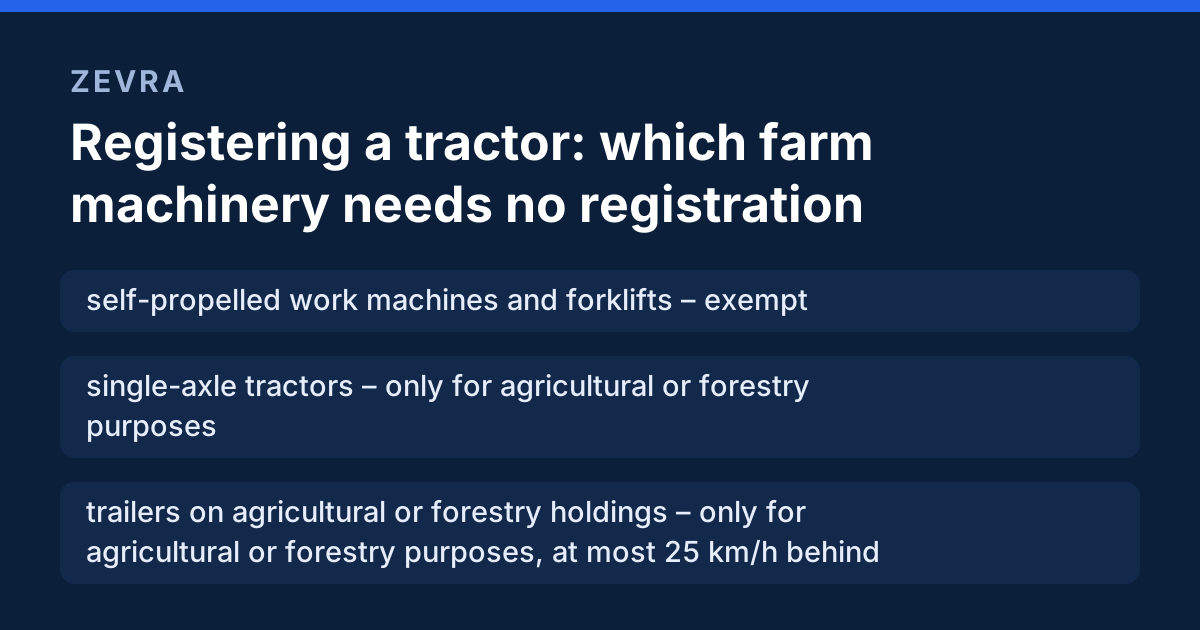
Among tractors, the ordinance exempts only the single-axle one – and only if it is used exclusively for agricultural or forestry purposes.
Which farm machines are exempt from registration?
Section 3 of the Vehicle Registration Ordinance lists the vehicles exempt from registration. 5 kinds concern agriculture and forestry.
| Vehicle | Condition |
|---|---|
| self-propelled work machines and forklifts | exempt |
| single-axle tractors | only for agricultural or forestry purposes |
| trailers on agricultural or forestry holdings | only for agricultural or forestry purposes, at most 25 km/h behind tractors or self-propelled work machines, marked under section 58 StVZO |
| agricultural or forestry implements | exempt |
| seat carts behind single-axle tractors or work machines | exempt |
On application, these vehicles can nevertheless be registered.
What do exempt farm machines still need?
Exempt from registration does not mean free of rules. Section 4 of the ordinance names 4 duties.
- Approval: the vehicle must conform to an approved type or have an individual approval. For an agricultural or forestry implement this applies only above 3 tonnes permissible total mass.
- Own plate: for self-propelled work machines and single-axle tractors with a design speed of more than 20 km/h. The rules on registration certificate part II do not apply here.
- Up to 20 km/h: the keeper marks first name, surname and place of residence, or company and registered office, permanently and legibly on the left side of the vehicle.
- Papers: without registration certificate part I, the certificate of conformity, the data confirmation or the individual approval must be carried. For trailers on agricultural or forestry holdings and for implements it is enough to keep them.
When is the tractor tax-exempt and gets a green plate?
The Motor Vehicle Tax Act exempts tractors (except semi-trailer tractors), special vehicles and trailers behind them as long as they are used exclusively for one of 5 purposes.
- on agricultural or forestry holdings
- for contract work for agricultural or forestry holdings
- for transport that starts or ends on an agricultural or forestry holding
- for carrying milk, skimmed milk, whey or cream
- by farmers or foresters for maintaining public green spaces or street cleaning on behalf of municipalities
If the keeper is exempt from the tax, a plate with green lettering on a white background is assigned. The assignment is noted in registration certificate part I.
Which interval applies to the general inspection?
Annex VIII of the Road Traffic Licensing Regulations names 3 intervals for tractors and trailers.
- tractors with a design speed of up to 40 km/h or up to 3.5 tonnes permissible total mass: every 24 months
- tractors over 3.5 up to 7.5 tonnes: every 12 months
- trailers marked for at most 40 km/h or weighing over 0.75 up to 3.5 tonnes: every 24 months
Does registration with a green plate work online?
For the internet-based procedure the Vehicle Registration Ordinance names the general plate as well as historic, seasonal and E plates. The green plate is not listed there; the application goes through the registration authority.
What does this mean for the farm machinery trade?
Zevra does not handle registrations with green plates. For all standard cases you use the dealer portal.
With Zevra, registration costs from €10, deregistration from €2 per case, net and plus official fees.
- Temporary registration proof: valid for 10 days
- Documents posted by the authority: within 6 days
- Digital deregistration: documents from 01.01.2015
- Digital registration: documents from 01.01.2018
- Registration with Zevra: €10 net
- Deregistration with Zevra: €2 net · base fee: €0
Deadlines and cut-off dates according to: Bundesministerium für Verkehr
Read more
- New registration online: register new cars digitally and hand over the same day
- Transfer online: re-register a used car to the buyer digitally
- Re-registration online: put deregistered vehicles back into service digitally
- Day registration online: first registration for one calendar day – digitally from the dealership
- Vehicle deregistration online: take vehicles out of service digitally – for dealers and fleets
- Change of address after a move: re-registering a vehicle online
- Vehicle registration by the dealer – also in another federal state
- Registration for used-car dealers: which vehicles work online?
- Registering a leased vehicle: who is the keeper – and where does the registration certificate part II stay?
- Registering a company car: which documents does each legal form need?
- Registering motorcycles and trailers online: what is the same for dealers – and what differs
- Registering motorhomes and caravans online: what dealers need to know
- Registering an electric car in Germany: tax exemption and E plate
- Importing an EU vehicle and registering it in Germany: what dealers need to know
- Registration without a valid HU: what is possible when the inspection has expired
- Keeper's change of name: having the vehicle documents changed
- Registering rental cars and taxis: reporting the use and meeting deadlines
- Certificate of destruction (Verwertungsnachweis): scrapping and deregistering a car
- Car sold: what seller and buyer must report to the authority
- Compulsory deregistration: when the authority takes a vehicle off the road
- Reporting vehicle changes: what must be reported without delay
- Registration offences: what section 77 FZV lists
- Car dealerships
- Registration services
- Fleet operators
- Caravan dealers
- Pricing
Sources: Fahrzeug-Zulassungsverordnung (FZV) § 3 – Notwendigkeit einer Zulassung · Fahrzeug-Zulassungsverordnung (FZV) § 4 – Voraussetzungen für die Inbetriebsetzung eines zulassungsfreien Fahrzeuges · Fahrzeug-Zulassungsverordnung (FZV) § 10 – Besondere Kennzeichen · Fahrzeug-Zulassungsverordnung (FZV) § 26 – Gemeinsame Regelungen für die internetbasierte Zulassung · Kraftfahrzeugsteuergesetz (KraftStG) § 3 – Ausnahmen von der Besteuerung · Straßenverkehrs-Zulassungs-Ordnung (StVZO) Anlage VIII – Untersuchung der Fahrzeuge · Sources