Returning an end-of-life vehicle: where does a vehicle go that is only fit for recovery? This page summarises § 3, § 4 and § 5 of the End-of-Life Vehicle Ordinance.
Zevra is the B2B platform for digital vehicle registration for car dealers, registration services and fleets: cases are entered in the dealer portal and filed nationwide by power of attorney with qualified electronic signature – from €10 per registration, no base fee, no minimum volume.
Last updated: · Zevra editorial team · Reviewed by M. Gabal, owner
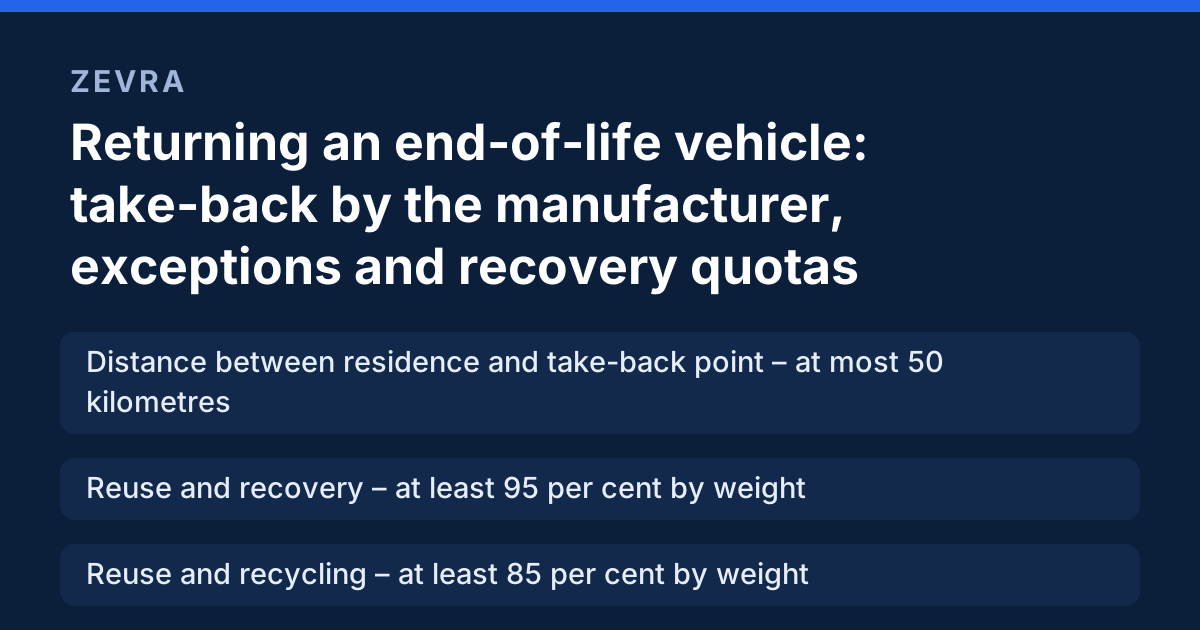
Who has to take back an end-of-life vehicle?
Vehicle manufacturers are obliged to take back all end-of-life vehicles of their brand from the last keeper.
Take-back is free of charge once the vehicle is handed over to a recognised take-back point or to a recognised dismantling facility designated by the manufacturer.
Which values does the Ordinance state?
| Rule | Value |
|---|---|
| Distance between residence and take-back point | at most 50 kilometres |
| Reuse and recovery | at least 95 per cent by weight |
| Reuse and recycling | at least 85 per cent by weight |
| Certificate for recognised facilities | valid for 18 months at most |
The quotas refer to the average empty weight of all end-of-life vehicles handed over per year.
Which exceptions does § 3 paragraph 4 list?
- The end-of-life vehicle is not registered in the European Union or was not last registered there.
- It was registered in the European Union for less than 1 month before decommissioning.
- Essential components are missing, such as drive, body, chassis, catalytic converter or electronic control units.
- Waste has been added to the end-of-life vehicle.
- The registration certificate Part II or a comparable document is not handed over.
To whom may the end-of-life vehicle be handed over?
The vehicle may only be handed over to a recognised collection point, a recognised take-back point or a recognised dismantling facility.
Only operators of recognised dismantling facilities issue the certificate of destruction.
Which facilities may accept end-of-life vehicles?
Operators of collection points, take-back points, dismantling facilities and shredder plants may only accept or treat end-of-life vehicles if their facility is recognised.
An expert certifies compliance with the requirements. For collection points and take-back points that are motor vehicle workshops, the competent motor vehicle guild certifies.
What does this mean for dealers?
For dismantlers, workshops and dealers this means: with the certificate of destruction the end-of-life vehicle is then taken out of service.
With Zevra the dealer files registration and deregistration in the dealer portal. Registration costs from 10 € per case, deregistration 2 € net, plus official fees.
- Certificate of destruction (Verwertungsnachweis): scrapping and deregistering a car
- Vehicle deregistration online: take vehicles out of service digitally – for dealers and fleets
- Compulsory deregistration: when the authority takes a vehicle off the road
- Export plates: exporting vehicles – what dealers need to know
- Handing over an end-of-life vehicle: duties of last keeper, collection point and dismantler
- Approving a dismantling facility: certificate, experts and requirements
- Temporary registration proof: valid for 10 days
- Documents posted by the authority: within 6 days
- Digital deregistration: documents from 01.01.2015
- Digital registration: documents from 01.01.2018
- Registration with Zevra: €10 net
- Deregistration with Zevra: €2 net · base fee: €0
Deadlines and cut-off dates according to: Bundesministerium für Verkehr
Read more
- Vehicle registration fees in Germany: official fees at the counter and online
- Operating licence lapsed: when modifications to the vehicle end it (§ 19 StVZO)
- Individual operating licence under § 21 StVZO: application, expert report and retention
- Historic vehicle report under § 23 StVZO: requirements for the H plate
- Compulsory motor insurance in Germany: duty to insure, term and penalty
- Minimum insured sums in German motor liability insurance: amounts per claim
- Making, selling and issuing number plates: notice duty under § 6b StVG
- Number plate misuse under § 22 StVG: punishable acts and penalty
- Fines in German vehicle registration: standard rates from the schedule of fines
- German vehicle tax: car rates by engine size and CO₂ (§ 9 KraftStG)
- German vehicle tax liability: start, end and minimum term under § 5 KraftStG
- German number plate size and font: dimensions, FE font and character count (annex 4 FZV)
- Paying German vehicle tax: yearly, half-yearly or quarterly (§ 11 KraftStG)
- German vehicle tax for motorhomes, vans and trucks: rates by total weight
- German vehicle tax and severe disability: exemption and reduction under § 3a KraftStG
- Trailer without vehicle tax in Germany: green plate and trailer surcharge (§ 10 KraftStG)
- Operating licence for vehicle parts under § 22 StVZO: licence, inspection and type mark
- Claims history statement in Germany: deadline, content and equal treatment (§ 5c PflVG)
- Foreign vehicle in Germany: insurance, Green Card and frontier insurance
- General operating licence for vehicle types in Germany: grant, duties and lapse (§ 20 StVZO)
- Design approval for vehicle parts in Germany: duty, test mark and exceptions (§ 22a StVZO)
- Vehicle tax notice in Germany: assessment, reassessment and tax base (§ 12 and § 8 KraftStG)
- E-scooter and other small electric vehicles in Germany: operating licence, insurance sticker and minimum age (eKFV)
- German vehicle tax: who is the tax debtor and what is taxed? (§ 7 and § 1 KraftStG)
- Provisional cover in German motor liability insurance: start, end and duties (KfzPflVV)
- Logbook order in Germany: order, entries and retention for keepers (§ 31a StVZO)
- Keeper liability for stopping or parking offences in Germany: when the keeper bears the costs (§ 25a StVG)
- Individual approval for vehicles in Germany: conditions, expert report and revocation (§ 13 EG-FGV)
- Carsharing vehicle: definition, marking and parking privileges (Carsharing Act)
- Checking the driving licence: what the keeper risks under § 21 StVG
- Recourse in motor liability insurance: obligations, purpose of use and maximum amounts
- Keeper liability under § 7 StVG: duty to compensate, maximum amounts and vehicles handed over
- Winter tyre rule: requirements, Alpine symbol and fines for driver and keeper
- Deregistering a car: disposal declaration, third country and the 7-year period (§ 17 FZV)
- Approving a dismantling facility: certificate, experts and requirements
- End-of-life vehicle rules: administrative offences and fines under § 11
- Handing over an end-of-life vehicle: duties of last keeper, collection point and dismantler
- Car dealerships
- Registration services
- Fleet operators
- Vehicle dismantlers
- Pricing
Sources: Altfahrzeug-Verordnung (AltfahrzeugV) § 3 – Rücknahmepflichten · Altfahrzeug-Verordnung (AltfahrzeugV) § 4 – Überlassungspflichten · Altfahrzeug-Verordnung (AltfahrzeugV) § 5 – Entsorgungspflichten · Sources · Vehicle figures: tax, insurance, fines