What distinguishes a carsharing vehicle legally from a rental car? This page summarises § 2 to § 5 of the Carsharing Act.
Zevra is the B2B platform for digital vehicle registration for car dealers, registration services and fleets: cases are entered in the dealer portal and filed nationwide by power of attorney with qualified electronic signature – from €10 per registration, no base fee, no minimum volume.
Last updated: · Zevra editorial team · Reviewed by M. Gabal, owner
What is a carsharing vehicle?
A carsharing vehicle is a motor vehicle offered to an indefinite number of drivers on the basis of a framework agreement.
The time or kilometre tariff includes the energy costs. The vehicle can be reserved and used independently.
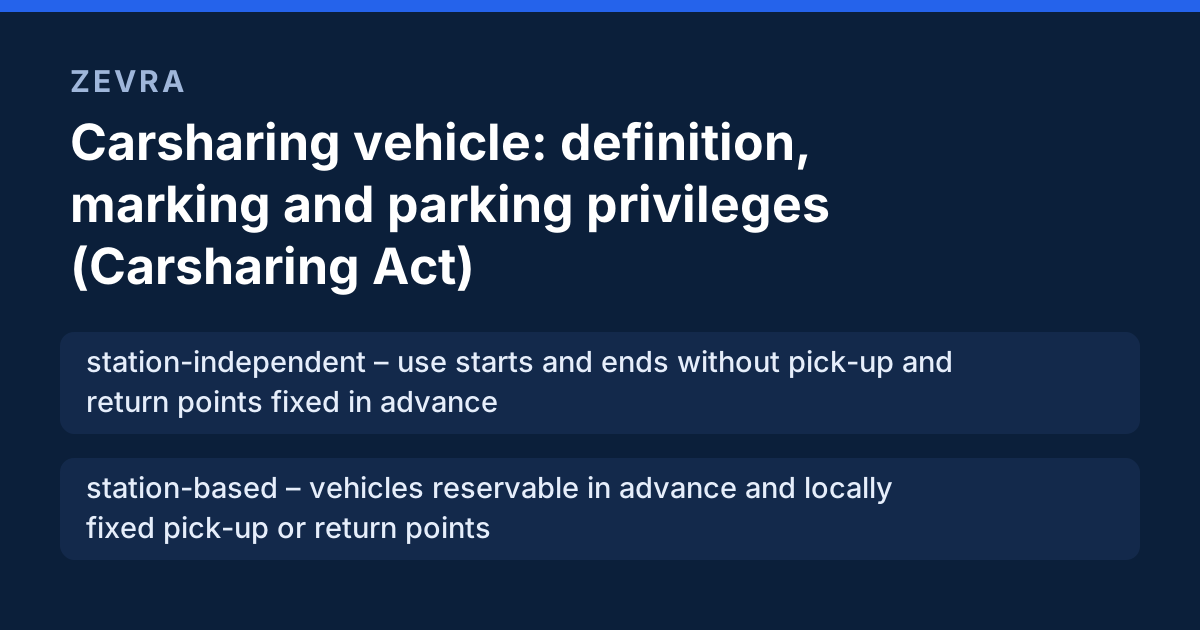
Which offer models does the Act know?
| Model | Feature |
|---|---|
| station-independent | use starts and ends without pick-up and return points fixed in advance |
| station-based | vehicles reservable in advance and locally fixed pick-up or return points |
| mixed form | a provider can combine both models |
A carsharing provider is a company regardless of its legal form.
Which privileges are possible?
- Privileges for parking on public roads or paths.
- Privileges in charging fees for this parking.
- Reductions of or exemptions from the fee obligation.
The safety and ease of traffic must not be impaired by this.
Why is the marking a requirement?
Privileges may only be granted for vehicles that carry a clearly visible marking as a carsharing vehicle.
Fees and expenses are charged for issuing the marking.
How are parking areas for station-based carsharing awarded?
The competent authority can designate suitable areas on through roads of federal roads. It awards them in a non-discriminatory and transparent selection procedure for 8 years at most.
If several providers meet the requirements, the decision is made by lot. A provider is unreliable if it has repeatedly and seriously breached duties under the Road Traffic Licensing Regulations.
What does this mean for dealers?
For rental companies and fleets with a carsharing offer this means: the vehicles are registered like other motor vehicles, and the privileges depend on the marking.
With Zevra the dealer files registration and deregistration in the dealer portal. Registration costs from 10 € per case, deregistration 2 € net, plus official fees.
- Registering rental cars and taxis: reporting the use and meeting deadlines
- Registering a company car: which documents does each legal form need?
- Keeper liability for stopping or parking offences in Germany: when the keeper bears the costs (§ 25a StVG)
- Logbook order in Germany: order, entries and retention for keepers (§ 31a StVZO)
- Keeper liability under § 7 StVG: duty to compensate, maximum amounts and vehicles handed over
- Winter tyre rule: requirements, Alpine symbol and fines for driver and keeper
- Temporary registration proof: valid for 10 days
- Documents posted by the authority: within 6 days
- Digital deregistration: documents from 01.01.2015
- Digital registration: documents from 01.01.2018
- Registration with Zevra: €10 net
- Deregistration with Zevra: €2 net · base fee: €0
Deadlines and cut-off dates according to: Bundesministerium für Verkehr
Read more
- Vehicle registration fees in Germany: official fees at the counter and online
- Operating licence lapsed: when modifications to the vehicle end it (§ 19 StVZO)
- Individual operating licence under § 21 StVZO: application, expert report and retention
- Historic vehicle report under § 23 StVZO: requirements for the H plate
- Compulsory motor insurance in Germany: duty to insure, term and penalty
- Minimum insured sums in German motor liability insurance: amounts per claim
- Making, selling and issuing number plates: notice duty under § 6b StVG
- Number plate misuse under § 22 StVG: punishable acts and penalty
- Fines in German vehicle registration: standard rates from the schedule of fines
- German vehicle tax: car rates by engine size and CO₂ (§ 9 KraftStG)
- German vehicle tax liability: start, end and minimum term under § 5 KraftStG
- German number plate size and font: dimensions, FE font and character count (annex 4 FZV)
- Paying German vehicle tax: yearly, half-yearly or quarterly (§ 11 KraftStG)
- German vehicle tax for motorhomes, vans and trucks: rates by total weight
- German vehicle tax and severe disability: exemption and reduction under § 3a KraftStG
- Trailer without vehicle tax in Germany: green plate and trailer surcharge (§ 10 KraftStG)
- Operating licence for vehicle parts under § 22 StVZO: licence, inspection and type mark
- Claims history statement in Germany: deadline, content and equal treatment (§ 5c PflVG)
- Foreign vehicle in Germany: insurance, Green Card and frontier insurance
- General operating licence for vehicle types in Germany: grant, duties and lapse (§ 20 StVZO)
- Design approval for vehicle parts in Germany: duty, test mark and exceptions (§ 22a StVZO)
- Vehicle tax notice in Germany: assessment, reassessment and tax base (§ 12 and § 8 KraftStG)
- E-scooter and other small electric vehicles in Germany: operating licence, insurance sticker and minimum age (eKFV)
- German vehicle tax: who is the tax debtor and what is taxed? (§ 7 and § 1 KraftStG)
- Provisional cover in German motor liability insurance: start, end and duties (KfzPflVV)
- Logbook order in Germany: order, entries and retention for keepers (§ 31a StVZO)
- Keeper liability for stopping or parking offences in Germany: when the keeper bears the costs (§ 25a StVG)
- Individual approval for vehicles in Germany: conditions, expert report and revocation (§ 13 EG-FGV)
- Returning an end-of-life vehicle: take-back by the manufacturer, exceptions and recovery quotas
- Checking the driving licence: what the keeper risks under § 21 StVG
- Recourse in motor liability insurance: obligations, purpose of use and maximum amounts
- Keeper liability under § 7 StVG: duty to compensate, maximum amounts and vehicles handed over
- Winter tyre rule: requirements, Alpine symbol and fines for driver and keeper
- Deregistering a car: disposal declaration, third country and the 7-year period (§ 17 FZV)
- Approving a dismantling facility: certificate, experts and requirements
- End-of-life vehicle rules: administrative offences and fines under § 11
- Handing over an end-of-life vehicle: duties of last keeper, collection point and dismantler
- Car dealerships
- Registration services
- Fleet operators
- Rental & car subscription
- Pricing
Sources: Carsharinggesetz (CsgG) § 2 – Begriffsbestimmungen · Carsharinggesetz (CsgG) § 3 – Bevorrechtigungen · Carsharinggesetz (CsgG) § 4 – Kennzeichnung · Carsharinggesetz (CsgG) § 5 – Sondernutzung öffentlichen Straßenraums · Sources