When does motor vehicle tax begin and end? This page sums up § 5 and § 7 of the German Motor Vehicle Tax Act for the trade.
Zevra is the B2B platform for digital vehicle registration for car dealers, registration services and fleets: cases are entered in the dealer portal and filed nationwide by power of attorney with qualified electronic signature – from €10 per registration, no base fee, no minimum volume.
Last updated: · Zevra editorial team · Reviewed by M. Gabal, owner
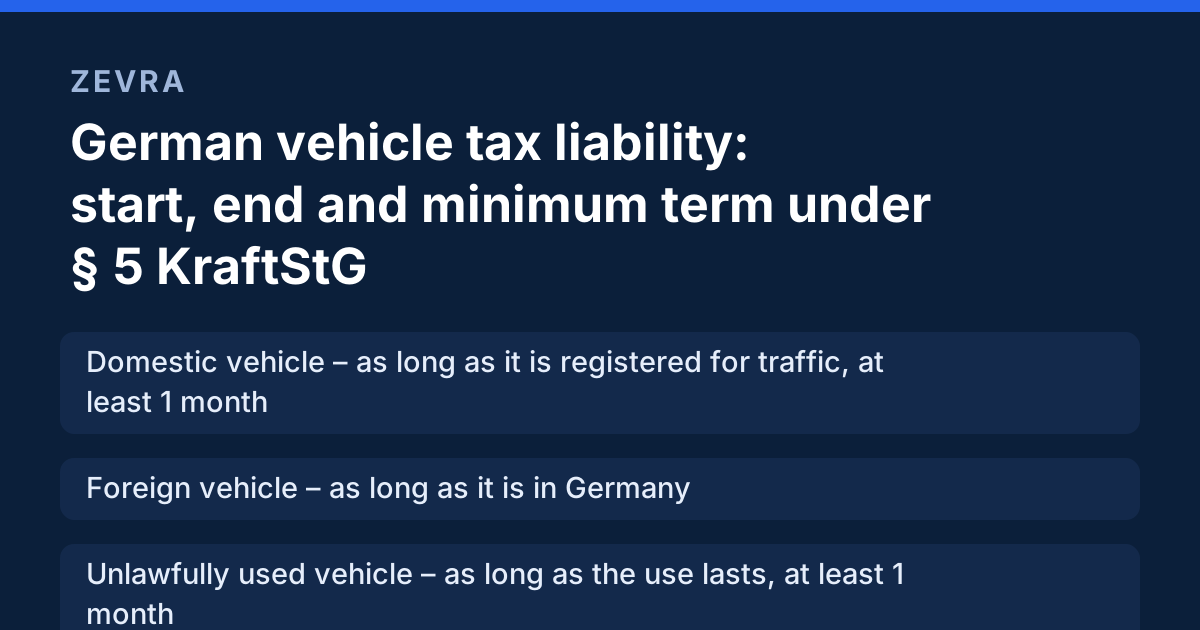
How long does tax liability last?
| Case | Duration |
|---|---|
| Domestic vehicle | as long as it is registered for traffic, at least 1 month |
| Foreign vehicle | as long as it is in Germany |
| Unlawfully used vehicle | as long as the use lasts, at least 1 month |
| Export plate | as long as the plate may be used, at least 1 month |
| Season plate | as long as the plate may be used, at least 1 month |
Who owes the tax?
- for a domestic vehicle, the person for whom it is registered for traffic,
- for a foreign vehicle, the person who uses it in Germany,
- for an unlawfully used vehicle, the person who uses it unlawfully.
This is governed by § 7 of the Motor Vehicle Tax Act.
Which day counts on deregistration?
If, on taking the vehicle out of service, the change in the registration certificate part I and the removal of the plate stamp happen on different days, the last day is decisive.
The competent authority can take an earlier date as a basis if the tax debtor shows credibly that the vehicle has not been used since then and that they did not culpably delay deregistration.
What happens when the vehicle is modified?
If a modification of the vehicle changes the amount of tax, tax liability for the modified vehicle begins with the change. The latest point is the handing over of the new or amended registration certificate part I.
At the same time the earlier tax liability ends.
How are days counted?
Started calendar days count as full days. The day on which tax liability ends is, as a rule, not counted.
What applies when a tax exemption ceases?
If the conditions for a tax exemption cease, tax liability begins when these conditions cease.
What does this mean for dealers?
For dealers, the customer's tax liability ends only when the vehicle is completely taken out of service.
With Zevra the dealer files registration and deregistration in the dealer portal. Registration costs from 10 € per case, deregistration 2 € net, plus official fees.
- German vehicle tax: car rates by engine size and CO₂ (§ 9 KraftStG)
- Vehicle tax at registration: SEPA mandate and tax arrears
- Vehicle deregistration online: take vehicles out of service digitally – for dealers and fleets
- Seasonal plates, E plates and H plates: applying online in Germany
- Paying German vehicle tax: yearly, half-yearly or quarterly (§ 11 KraftStG)
- German vehicle tax and severe disability: exemption and reduction under § 3a KraftStG
- Vehicle tax notice in Germany: assessment, reassessment and tax base (§ 12 and § 8 KraftStG)
- German vehicle tax: who is the tax debtor and what is taxed? (§ 7 and § 1 KraftStG)
- Temporary registration proof: valid for 10 days
- Documents posted by the authority: within 6 days
- Digital deregistration: documents from 01.01.2015
- Digital registration: documents from 01.01.2018
- Registration with Zevra: €10 net
- Deregistration with Zevra: €2 net · base fee: €0
Deadlines and cut-off dates according to: Bundesministerium für Verkehr
Read more
- Vehicle registration fees in Germany: official fees at the counter and online
- Operating licence lapsed: when modifications to the vehicle end it (§ 19 StVZO)
- Individual operating licence under § 21 StVZO: application, expert report and retention
- Historic vehicle report under § 23 StVZO: requirements for the H plate
- Compulsory motor insurance in Germany: duty to insure, term and penalty
- Minimum insured sums in German motor liability insurance: amounts per claim
- Making, selling and issuing number plates: notice duty under § 6b StVG
- Number plate misuse under § 22 StVG: punishable acts and penalty
- Fines in German vehicle registration: standard rates from the schedule of fines
- German vehicle tax: car rates by engine size and CO₂ (§ 9 KraftStG)
- German number plate size and font: dimensions, FE font and character count (annex 4 FZV)
- Paying German vehicle tax: yearly, half-yearly or quarterly (§ 11 KraftStG)
- German vehicle tax for motorhomes, vans and trucks: rates by total weight
- German vehicle tax and severe disability: exemption and reduction under § 3a KraftStG
- Trailer without vehicle tax in Germany: green plate and trailer surcharge (§ 10 KraftStG)
- Operating licence for vehicle parts under § 22 StVZO: licence, inspection and type mark
- Claims history statement in Germany: deadline, content and equal treatment (§ 5c PflVG)
- Foreign vehicle in Germany: insurance, Green Card and frontier insurance
- General operating licence for vehicle types in Germany: grant, duties and lapse (§ 20 StVZO)
- Design approval for vehicle parts in Germany: duty, test mark and exceptions (§ 22a StVZO)
- Vehicle tax notice in Germany: assessment, reassessment and tax base (§ 12 and § 8 KraftStG)
- E-scooter and other small electric vehicles in Germany: operating licence, insurance sticker and minimum age (eKFV)
- German vehicle tax: who is the tax debtor and what is taxed? (§ 7 and § 1 KraftStG)
- Provisional cover in German motor liability insurance: start, end and duties (KfzPflVV)
- Logbook order in Germany: order, entries and retention for keepers (§ 31a StVZO)
- Keeper liability for stopping or parking offences in Germany: when the keeper bears the costs (§ 25a StVG)
- Individual approval for vehicles in Germany: conditions, expert report and revocation (§ 13 EG-FGV)
- Car dealerships
- Registration services
- Fleet operators
- Leasing companies
- Remarketing & resellers
- Pricing
Sources: Kraftfahrzeugsteuergesetz (KraftStG) § 5 – Dauer der Steuerpflicht · Kraftfahrzeugsteuergesetz (KraftStG) § 7 – Steuerschuldner · Kraftfahrzeugsteuergesetz (KraftStG) § 9 – Steuersatz · Sources · Vehicle figures: tax, insurance, fines